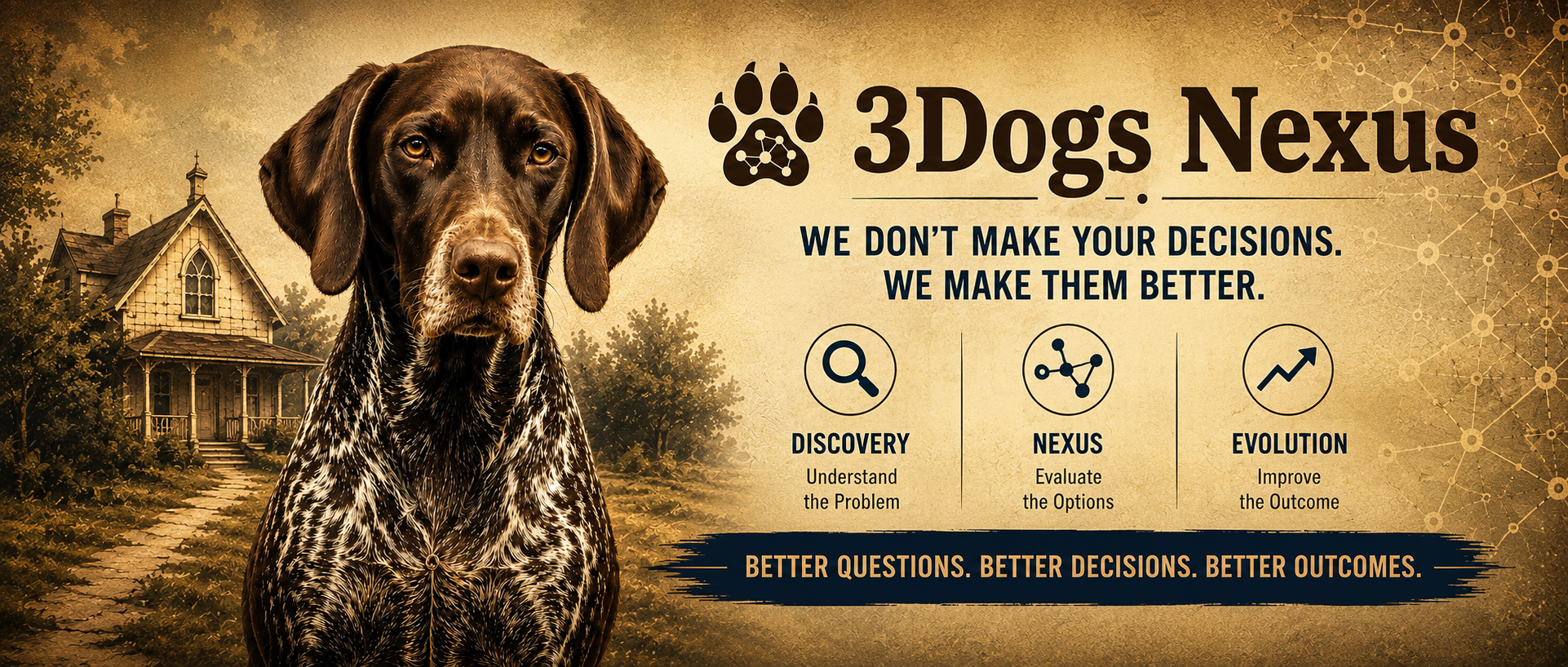
We don't make your decisions.
We make them better.
Decision-Support Infrastructure
Built for executives, operators, advisors, and consultants who need deeper research, structured challenge, and more rigorous decision support.
Structured Orchestration
3Dogs coordinates a disciplined process that moves from problem clarification to research, adversarial challenge, and documented recommendations.
Disciplined Methodology
The real value is the methodology used to stress-test assumptions, surface hidden risks, and reduce blind spots before resources are committed.
Strategic Accountability
Final decisions, implementation, and accountability remain entirely with the human leadership team.
Better decisions rarely come from faster answers. They come from disciplined processes, rigorous challenge, and informed judgment.
Organizations make expensive decisions every day.
Hire or wait? Expand or consolidate? Acquire or build? Invest or preserve cash? Enter a new market or stay focused?
These decisions often happen under pressure, with partial information, competing opinions, and finite resources.
3Dogs exists to improve decision quality before money, people, time, or reputation are committed.
Better questions reduce confusion. Better decisions reduce risk. Better outcomes create value.
Large organizations maintain teams of analysts, researchers, and advisors to stress-test important decisions.
Small business owners, solo consultants, boutique firms, and leadership teams face similar challenges with far fewer resources.
3Dogs provides decision-support infrastructure normally associated with much larger organizations while keeping human judgment and accountability firmly in control.
A typical AI tool gives you an answer. 3Dogs gives you a decision process.
The objective is not a faster answer. The objective is a better decision.
- Business owners evaluating growth, hiring, technology, operations, financing, and risk.
- Solo consultants and boutique firms seeking added research, challenge, and decision-support capacity.
- Professional advisors including accountants, attorneys, engineers, fractional CFOs, and fractional executives.
- Leadership teams responsible for strategic, operational, and capital allocation decisions.
- Organizations that need better decisions but do not maintain dedicated internal analyst or consulting teams.
- Strategic planning and growth decisions
- Capital allocation and investment trade-offs
- Technology adoption and implementation risk
- Hiring, staffing, and organizational design
- Market entry and product strategy
- Operational change and process redesign
- Risk assessment and crisis response planning
- Public policy and multi-stakeholder decisions
| Question | Typical AI Tool | 3Dogs Nexus |
|---|---|---|
| Starting point | User prompt | Structured intake and Discovery |
| Core behavior | Generates answers from a single prompt. | Coordinates a structured decision pipeline that clarifies problems, conducts external research, enforces adversarial deliberation, and documents reasoning before decisions are made. |
| Risk handling | May sound confident even when assumptions are weak | Designed to surface missing information, blind spots, and implementation risk |
| Human role | User accepts, edits, or ignores the output | Human judgment remains central; recommendations are advisory |
| Output | An answer | A documented decision process |
A single answer can sound convincing while still missing important risks, alternatives, assumptions, or stakeholder concerns. 3Dogs is built to reduce that failure mode.
Structured analysis. Human accountability. Better decisions.
3Dogs is operational today: intake, clarification, decision brief generation, multi-perspective analysis, and structured recommendation output are live.
Most organizations do not fail because people are careless. They fail because the right question was never fully defined.
Discovery helps identify missing information, conflicting assumptions, hidden constraints, and unanswered questions before time, money, or reputation are committed.
Better questions lead to better decisions.
Nexus evaluates alternatives, challenges assumptions, identifies risks, and highlights opportunities before decisions are made.
The objective is not more information.
The objective is better judgment.
Most organizations lose valuable experience after projects, initiatives, and decisions are completed.
Evolution captures systemic patterns, execution data, and workflow gaps for human-reviewed governance and continuous improvement.
Experience becomes an auditable operational asset.
Nexus improves the decision.
Evolution improves what happens next.
Evolution records patterns, execution data, and workflow observations to support governance, quality assurance, and continuous improvement. System optimizations remain subject to human review and approval.
Bad hires.
Failed projects.
Poor investments.
Technology decisions that create years of technical debt.
Expansion plans that never generate expected returns.
Most organizations recognize the warning signs after the decision.
3Dogs is designed to identify more of them before the decision.
- Avoid expensive mistakes: identify risks before they become commitments.
- See more options: evaluate alternatives that may otherwise be overlooked.
- Challenge assumptions: stress-test decisions before resources are invested.
- Support advisors: give consultants and professionals additional decision-support capacity.
- Retain knowledge: preserve lessons learned so experience compounds over time.
- Improve outcomes: better decisions lead to better results.
3Dogs uses a multi-stage orchestration process designed to improve decision quality.
The platform clarifies the problem, identifies missing information, researches relevant factors, evaluates multiple perspectives, challenges assumptions, identifies risks and alternatives, and documents recommendations and reasoning.
Technology evolves.
Better decisions remain the goal.
3Dogs brings strategy consulting capabilities into a guided, repeatable, technology-supported process.
It supports small operators, solo consultants, boutique firms, and leadership teams that need stronger analysis without assembling a full advisory team.
Built to help people make better decisions, including the consultants and advisors who guide them.
The cases below are simulated decision studies used to test and explain the 3Dogs workflow. They are not presented as paid client engagements or customer results.
Nevada Lithium Mining Complex
Decision: whether a major resource project should proceed, and under what conditions.
Improved outcome: a staged governance process balancing economic value, water risk, tribal interests, environmental protection, and long-term accountability.
Southwest Malaria Outbreak
Decision: how to respond to a fast-moving outbreak without locking into the wrong response too early.
Improved outcome: treatment-first action, tribal co-management, water safeguards, healthcare capacity gates, and automatic escalation triggers.
Independent Auto Repair EV Transition
Decision: whether to invest heavily in EV capability or preserve cash while the market develops.
Improved outcome: a staged hybrid-first strategy that protects cash, staff trust, customer needs, and future optionality.
Small organizations face enterprise-scale complexity with a fraction of the resources.
Hiring, pricing, cash flow, compliance, technology, risk, and growth decisions all demand serious judgment.
3Dogs gives operators and advisors a structured decision process normally associated with larger teams.
- Live prototype operational
- Guided clarification active
- Decision brief generation active
- Multi-perspective analysis active
- Structured recommendations active
- Private demonstrations available now
Commercialization
- Launch paid pilot engagements
- Convert early adopters into recurring subscriptions
- Package private demonstrations and customer onboarding
Platform Readiness
- Finalize AWS Marketplace onboarding and commercial deployment channels
- Complete security, audit, and production hardening initiatives
- Formalize governance and continuous improvement processes
Strategic Growth
- Expand guided discovery and intelligent recommendation workflows.
- Scale customer onboarding and enterprise delivery capabilities.
- Utilize AWS Activate credits already awarded to the company to substantially offset core AI and cloud operating expenses, increasing capital efficiency and accelerating early commercial growth.
The core workflow is operational. Current priorities are commercialization, AWS Marketplace readiness, security hardening, customer delivery, and scale.
- Private demonstrations available now
- Paid pilot engagements being packaged
- Early-access use cases under evaluation
- Subscription and marketplace deployment paths in development
The platform is moving from prototype validation toward paid commercial use.
The opportunity is scaling structured decision support.
Every decision creates knowledge. Every outcome creates evidence. Most organizations lose both.
3Dogs helps capture decision patterns, preserve lessons, and make experience useful over time.
Better Questions. Better Decisions. Better Outcomes.
Example cases are simulated scenarios used to demonstrate workflow and decision process. They are not presented as customer results.
This website copy and visual imagery were created, enhanced, or refined with AI assistance.